
Turning Tragedy Into Triumph: Redefining What It Means To Be Asian
By Jeffery Tram
What does it mean to be Asian? It is a question I find myself asking everyday.
Finding and accepting your identity is something many people struggle with. I was one of them.
With everything I experienced as a child, I truly hated myself. I hated being Asian, and I wished everyday that I was a white person so I could fit in.
With the recent Atlanta shooting that targeted Asian women and the overall rise of anti-Asian attacks since the start of the pandemic, I really hate that I ever had thoughts like that in my head.
I grew up in a predominantly white town, where I was always the only Asian in the room. I remember being the butt end of many Asian jokes and stereotypes. They used to pull their eyes back to create slanted eyes. I heard so many things like “ching chong” and “I could blindfold you with dental floss” and many more insults. Even the teachers would do it. I remember when they would always pick on me to answer the questions in class, saying “you would know the answer,” which plays into the “all Asians are smart” stereotype.
What saved me from being white-washed was watching Asian YouTubers, where they showed a glimpse of Asian culture, especially Asian-American culture. Although there were things I could relate to, there were also things I couldn’t. I didn’t have any Asian friends, and I couldn’t relate to the cultural norms that came with that. How is it that I am an Asian person, but I feel foreign to my own identity?
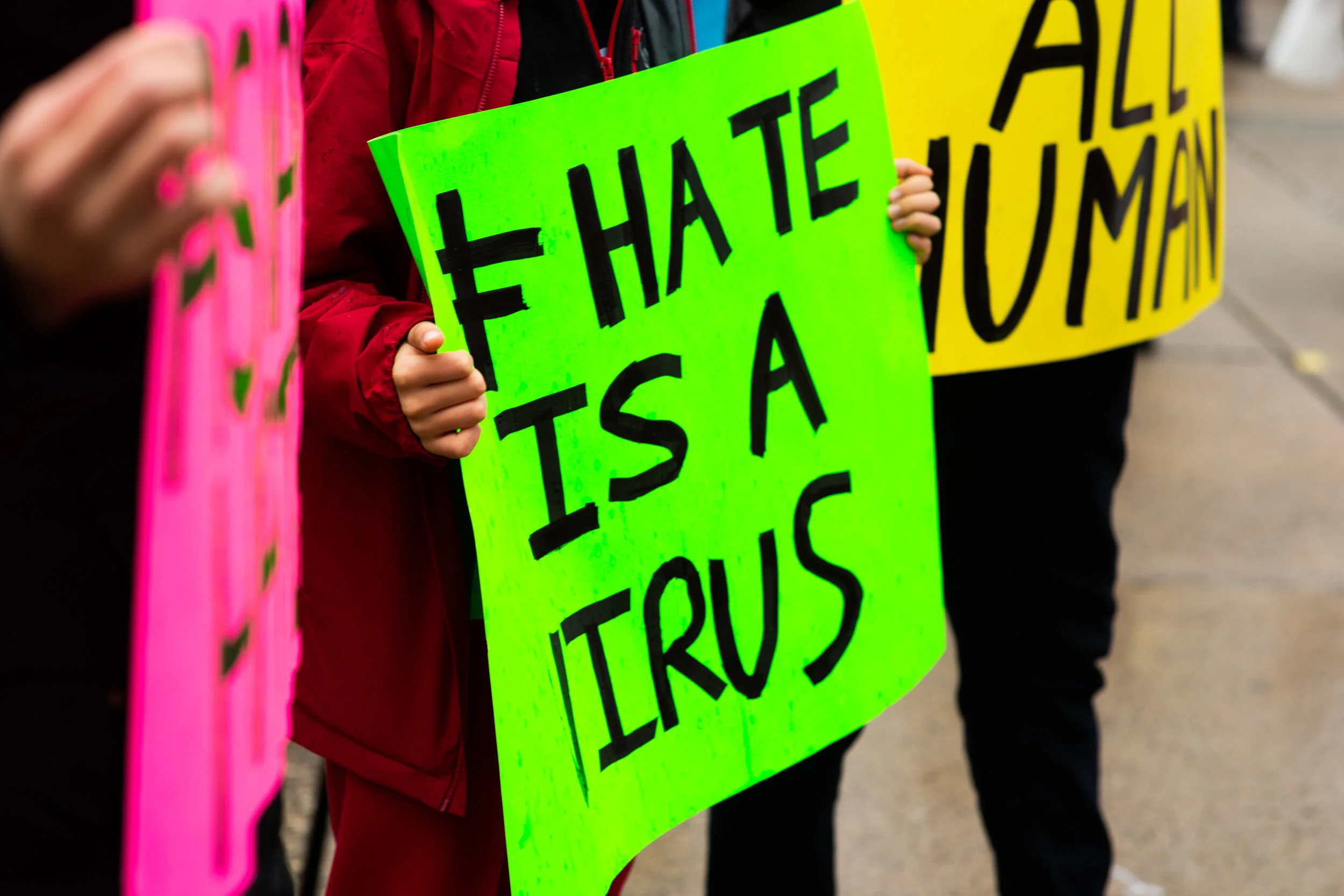
A protester holds a 'Hate is a virus’ sign in Nathan Phillip Square in Toronto for the Anti-Asian Hate protest in April. Photo cred: Johanna Hernandez
When I went to university, I got to experience a more diverse environment. For example, I got to see the community of the Nigerian students and how prideful they were of their identity. I realized how much I was craving that with my community.
In a conversation I was having with my fellow journalism student and friend John Gallardo, I was expressing my frustration on how I did not know what it meant to be an Asian person. It became the inspiration for the creation of my show, the AZN Connection. The concept of the show is that listeners who could relate to the experience of their lack of Asian identity like us could join us on that journey to explore all the concepts of what it means to be an Asian person. Me, John Gallardo, and Rhea Lisondra wanted to balance the fun light-hearted cultural references with the harsh truths about our community.
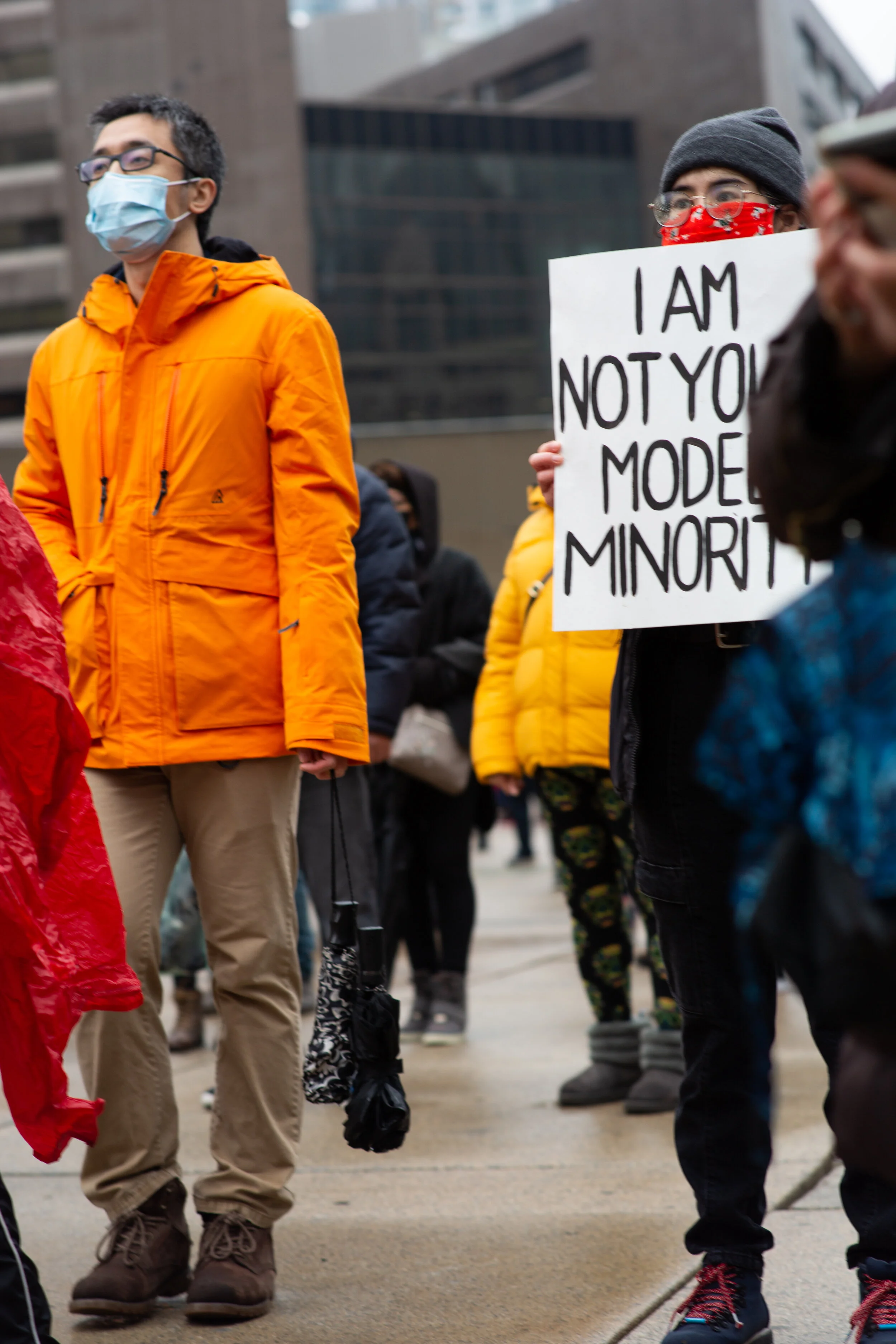
Protesters gather an hold signs in Nathan Phillip Square in Toronto for the Anti-Asian Hate protest in April. Photo cred: Johanna Hernandez
With the rise of the anti-Asian attacks, we felt like it was important to start the dialogue on all angles of the conversation. That in itself is a concept that wasn’t very prevalent in our community.
A big problem in our Asian community was our silence toward everything. It was a culture that was ingrained in our households. Our parents sacrificed a lot when escaping war-torn countries, oppression, and danger to build a new life in a new country. Because of that, their main goal for us living in a western country was to succeed in school so that we could ultimately become financially stable in the future. The flaw in this ideology is that it limits the perspective of the Asian child to have school as the sole focus. It neglects all the other aspects of what it means to be a human being.
It is why mental health is so neglected in our communities. If I were to ever talk about anything other than school in my household, the conversation would quickly shift right back to that. If I ever expressed a complaint or frustration at any point in my life, it would automatically be redirected to a comment about how much they have sacrificed and that we have it easier.
Growing up in an environment like that can affect the way you view the world. I was fortunate to break out of that early on, but for many Asians, they live their lives in a bubble where perspectives are limited to their immediate circle. Living in that way is why other communities, especially the black community, have felt resentment toward the Asian community. Now of course there are other things, like the apparent anti-Blackness in some Asian cultures, but the root of everything is the silence from the majority.
The day after the Atlanta shooting, I was on Clubhouse all day listening to the reactions in several rooms. There were many emotions that were expressed. Of course, there was sadness toward the victims and their families. There was anger that another white terrorist was sympathized by the systems that continuously enabled white supremacy. But the reaction that stood out the most to me by the Asian community was numbness. They were in a state of not knowing how to feel. I heard people talk about how for the first time in their life, they saw a blatant act against their heritage. For them, it was the first time they really looked at themselves as a community and realized the bubble they were living in.
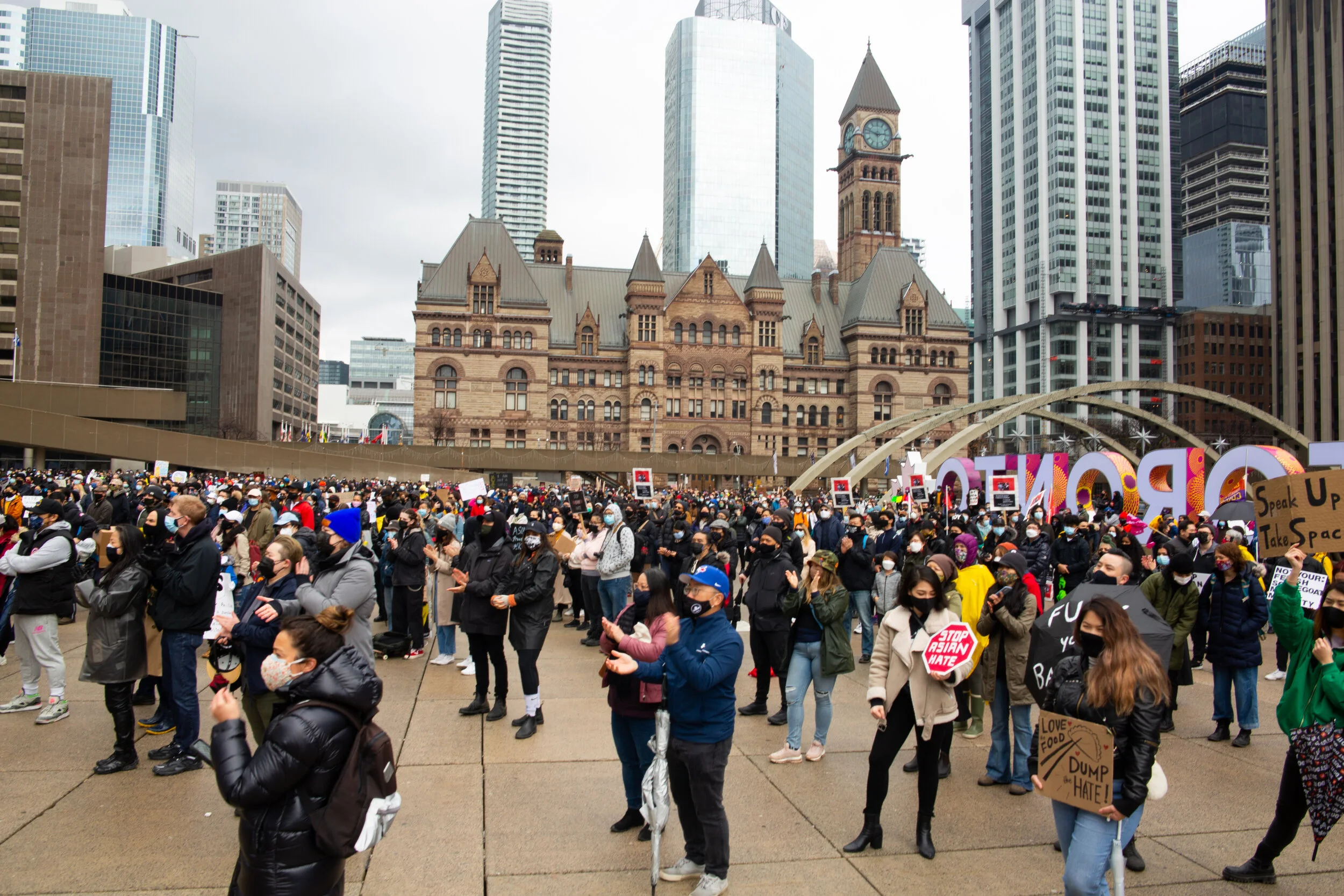
More than 5000 people gathered in Nathan Phillip Square in Toronto for the Anti-Asian Hate protest in April. Photo cred: Johanna Hernandez
Through the many Clubhouse rooms and the anti-Asian attack rally I attended in Toronto, what was encouraging for me was that there was finally real dialogue toward change. I got to talk to other Asians who were saying they wanted to learn more about politics and social activism. There are people who are learning about new perspectives about their identity, which broadens their view of the world.
This is exactly one of the things that I fight for in my work. I have never been more proud to be Asian, and everything I do is toward promoting love and pride in our community. I’ve dedicated my life toward this because I truly care about my community, and I want more people to think like this because we are capable of so many things if we just address the issues within. We can unite with other communities toward addressing the common enemy: white supremacy.
These themes are reflected in the work we do with the AZN Connection. You can follow the page on Instagram @azn_connection where we go into more depth around the difficult conversations surrounding the community. This includes amplifying different perspectives to allow for a more broadened view.
Sometimes it takes a real tragedy for there to be change. Although I wish none of those hate crimes occurred, hopefully, we can try to turn this into substantial change for our community and the world.
